How can we detect disease before it destroys the brain?
Neurodegenerative diseases can quietly damage the brain. They can erode memory, alter personality and gradually take away independence. Detecting them before these changes become apparent is a difficult problem we urgently need to solve.
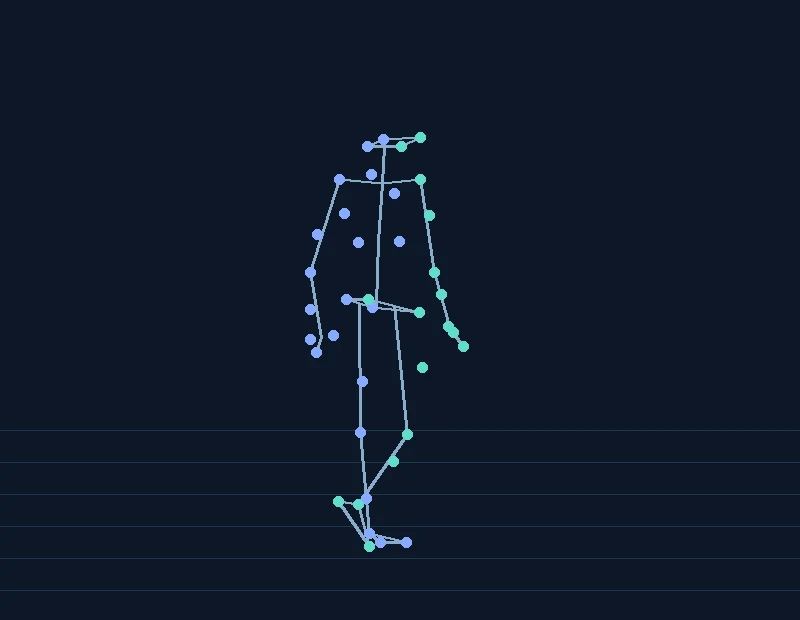
Recorded motion · marker view
ViewDrag to rotate
Real recording
A step is more than a movement.
Follow the markers through a short walking recording. Left and right sides form two rhythms. Their timing and coordination are part of what makes gait interesting to study.
LeftRight
39 measured markers · 6-second excerpt. Display reduced from 100 to 25 frames/s. Connecting lines use marker midpoints as visual guides, not reconstructed bones.
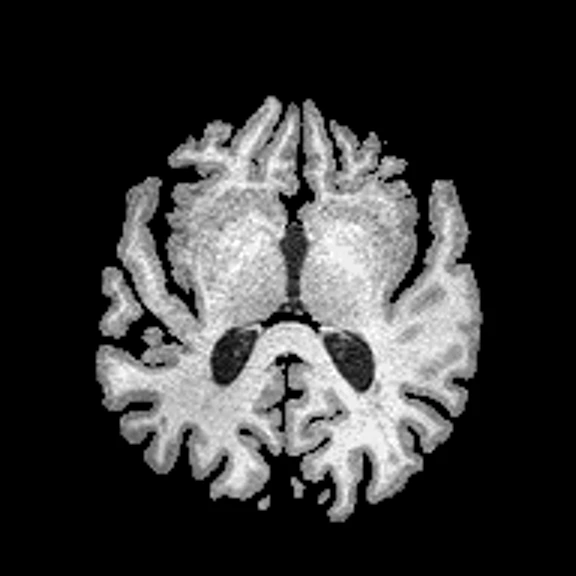
Move through real T1 brain slices or rotate the segmented anatomy. Volumes and spatial relationships provide features that interpretable models can examine.
ThalamusHippocampusCaudate
Skull-stripped brain; normalized display contrast. 3D surface simplified for the web. Illustrative exploration, not a diagnostic viewer.
MRI data source: PPMI. Segmentation: FreeSurfer. Visualisation prepared for this website.
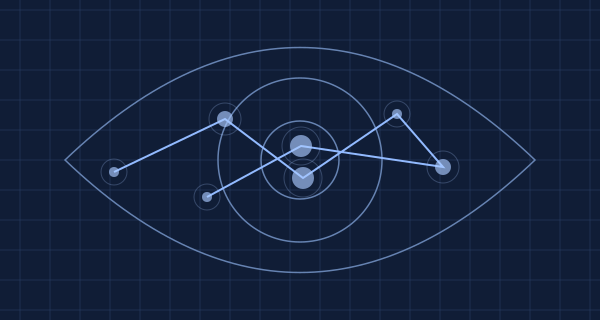
The target moves; the eye responds after a delay. Compare target and gaze trajectories while adjusting response latency during smooth pursuit or target jumps.
TargetGaze
Conceptual simulation. Target motion and eye response are synthetic, not a patient recording or a validated physiological model.
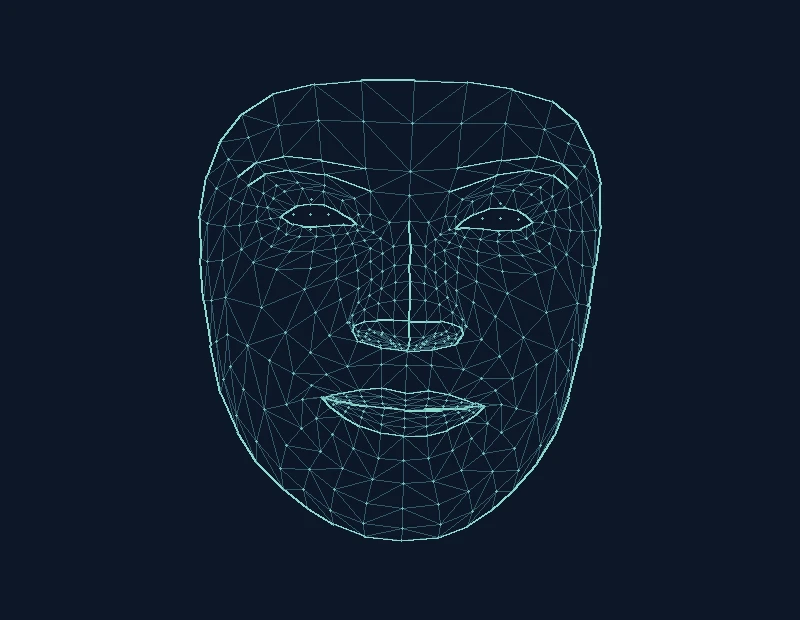
A blink, a raised eyebrow, a movement of the lips. We extract 478 facial landmarks from a video and connect them into a moving mesh you can explore from every angle.
478 landmarks25 frames/s
Landmarks detected in recorded video. Depth is estimated by a model, not measured by a 3D scanner. Facial motion visualization, without emotion labels or diagnosis.
What changes before the disease becomes clinically obvious? Cognitive, gait, imaging,
eye-movement, and facial-expression patterns may carry early signs of neurological change.
Build interpretable models
A prediction is not sufficient if nobody can understand why it was made. Models need to be
transparent enough for researchers and clinicians to inspect, challenge, and understand.
Connect patterns to disease
Digital biomarkers matter when they connect measurement to mechanism: what can a signal
say about Parkinson's disease, Alzheimer's disease, and related disorders?
02 / Research
Selected publications
Selected work on digital biomarkers, interpretable machine learning, and neurodegenerative disease. Browse by research area below.
Artur Chudzik, Albert Śledzianowski, Andrzej W Przybyszewski
Reviews how online cognitive tests, eye tracking, movement data, and other digital
biomarkers can support AI-based detection of early Parkinson's and Alzheimer's disease.
Uses T1 MRI scans and interpretable machine-learning features based on brain-region
volumes and spatial relationships to distinguish healthy controls, prodromal cases, and Parkinson's disease.
Artur Chudzik, Artur Szymański, Jerzy Paweł Nowacki, Andrzej W. Przybyszewski
Uses diffusion tensor imaging and data mining to estimate symptom development after
deep brain stimulation.
03 / About
Dr Artur Chudzik
Artur Chudzik, PhD, is an AI engineer and scientist building explainable AI for earlier detection
of Parkinson's and Alzheimer's disease. His work turns subtle patterns in cognition, gait,
facial expression, eye movements, and brain imaging into interpretable digital biomarkers for
monitoring disease and guiding treatment decisions. He holds a PhD in Computer Science from
the Polish-Japanese Academy of Information Technology and is a member of the Digital Biomarkers
in Neurodegenerative Diseases research group. He also has more than a decade of experience in
software engineering and applied AI, which helps him turn research ideas into reliable,
transparent, and practical systems.
My work asks a simple question: can we detect neurodegenerative disease earlier
by learning from subtle patterns in behavior, cognition, and the brain?
Neurodegenerative diseases are brain diseases in which nerve cells gradually lose
function and die. Timing matters because visible motor symptoms in Parkinson's disease often appear
only after many dopamine-producing neurons in the substantia nigra are already dead.
In Alzheimer's disease, damaging brain changes can begin decades before dementia
is diagnosed. The disease process can be underway while the
evidence still looks incomplete, ambiguous, or too late to act on confidently.
Earlier signals can help clinicians monitor risk, choose interventions, and adjust treatment
before the disease trajectory becomes harder to change.
The methodological challenge is not only to classify disease, but to make the evidence
behind a prediction understandable. That is why this work combines brain imaging, online
cognitive testing, eye tracking, movement analysis, facial expression analysis, and other
digital biomarkers with interpretable machine-learning methods.
EducationM.Sc.
and
B.Sc.
in Computer Engineering, Rzeszow University of Technology
Peer reviewVerified reviewer
for journals including Communications Medicine, Scientific Reports,
NeuroImage, Journal of Alzheimer's Disease, and Sensors
How do space and time work? What can observations of the distant cosmos tell us about the laws of physics? In this research, I use mathematical models and computation to test different ways of describing the Universe.
Explore the questions and research ↓
Mathematics · 2025
Could time be the scale of space?
Artur Chudzik
We usually ask how the Universe changes with time. What if we turn the question around: could a change in the scale of space measure the passage of time? This paper explores the mathematical relationship between the scale of the Universe and cosmic time, comparing models with observations.
As space expands, distances between galaxies increase.
If space expands at different rates, how does time pass within it?
Click a galaxy or use the button to change the reference point. The gold point marks the selected observer. An illustration of uniform expansion, not a sky map or a fitted model.
05 / Connect
Profiles and contact
Find my publications, code and academic profiles at these addresses.
 Digital biomarkers